RefletsNews · Boldness and instinct
At the back of the standing pen, an engaged couple danced to 245,300 views at The Weeknd in Singapore
A clip of two fiancés dancing at the back of the standing pen at The Weeknd's National Stadium show in Singapore on October 3, 2026 has passed 245,300 views. Lab work on dancing in time suggests why moving together is bonding, within narrow limits.

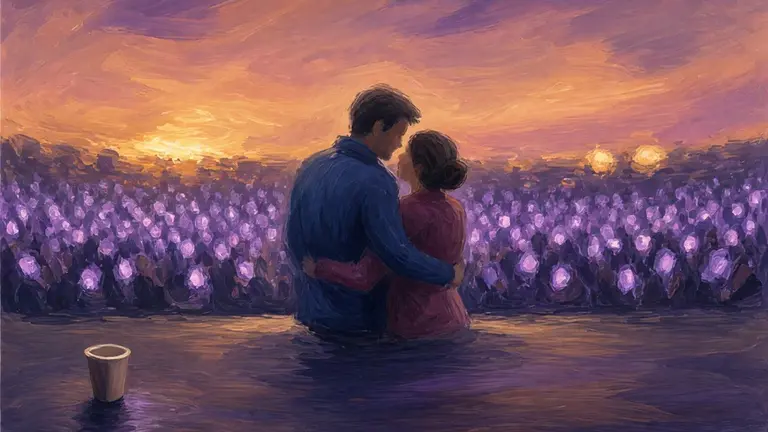
“Us in our element at the back of the standing pen, dancing like it was our dance floor.” That is how a TikTok user captioned her video of herself and her fiancé at The Weeknd's concert at the National Stadium in Singapore on October 3, 2026. A second clip, filmed by a stranger, has passed 245,300 views, according to Stomp, the Singapore news site that reported it.
A dance floor of their own
The woman wrote that the evening was “our last concert as bachelors”. Stomp gives no wedding date, and the site says she declined to comment because the sudden attention had been overwhelming.
The clip that took off was posted by another TikTok user, captioned “Saw the cutest couple today at The Weeknd”. It shows the pair dancing together away from the main crowd. Other videos followed. One Instagram page captioned its version with a joke about whose parents these were, and at least one commenter took the joke at face value.
Then one of the two turned up in the comments. “That’s me and my fiancee,” he wrote, adding that they were surprised to see themselves there “just by being in our own world”.
Commenters mostly approved. One wrote: “They are present and living in the moment and not recording everything on their phones.” The remark is a small joke on itself, since every comment exists because someone did hold up a phone. This writer has filmed a few sunsets too.
What is checkable in the story is short: a couple, a stadium, a camera that was not theirs. The pair had no audience in mind when they started to move, and the audience arrived afterwards.
The stadium around them
The setting was big. According to the Singapore music site Bandwagon, The Weeknd, whose real name is Abel Tesfaye, played the opening night of his Singapore dates on October 2, 2026 to 55,000 fans, in a two-hour, 39-song set. His last visit eight years earlier had been to a Singapore Indoor Stadium audience of 7,000.
Bandwagon describes a 12-metre rotating golden robot sculpture, lasers, bursts of flame and synchronised LED wristbands that extended the light show into the stands. “Starboy” and “Blinding Lights” brought fans in the seated sections to their feet, the review says.
Stomp says the October 3 show was part of the final Asian leg of the After Hours Til Dawn Tour. Bandwagon's figures cover the opening night, so the attendance on the night of the viral clip is not stated by either outlet.
Bandwagon also reports that Tesfaye took off his glittering mask about 20 minutes into the set, smiled and greeted the audience with an air hug, worked the city's name into the lyrics of “Faith” and “Save Your Tears”, and went down towards the floor several times to hold out the microphone for sing-alongs. The review's closing image is the unaccompanied roar of the chorus of “One Of The Girls”, which it says the production could never programme. The stadium, in other words, was built to send a crowd of tens of thousands in one direction, towards one stage. The couple spent their evening facing each other instead, and that is the whole reason the clip travelled.
In a crowd like that, the couple's choice is the quiet one. They stayed at the back, with space around them, and danced only with each other.
What tango dancers' brains did
Dancing as a pair has been put under a lab cap this year. On May 4, 2026, the University of Colorado Boulder published a study led by Thiago Roque, a graduate student at its ATLAS Institute, in which pairs of Argentine tango dancers wore electroencephalogram (EEG) caps, which measure electrical activity in the brain, and movement sensors on their ankles.
When the leader stepped forward and the follower stepped back within 200 milliseconds or less, their brain waves tended to match up, rising and falling at about the same time. When the steps were out of sync, so were the brains. This held for a range of brain waves, including beta and theta waves. “When we dance, our brains are actually coupling,” Roque said.
The researchers call this “interbrain coupling” or “neural synchronization”. They say it had been seen in other social activities, such as playing duets on the guitar, but never before in dancing.
Roque's team also built a wrist device that vibrates when the dancers' brain waves line up. Ruojia Sun, a co-author who also danced in the study, tried it with her longtime partner. “It almost enhanced that feeling of connection,” she said.
A word about size, because the headline is bigger than the sample. The study used five pairs of experienced tango dancers, and Roque presented the results in March at the 20th International Conference on Tangible, Embedded and Embodied Interaction in Chicago. The wearable is, in the university's words, still in its early stages. Roque says he would like to flip its settings so that it buzzes when dancers fall out of tune and goes silent when they are in step, and he sees such tools helping teammates in soccer or cycling learn to read each other without speaking. Tango also differs from dancing at the back of a standing pen: it is rarely choreographed, and partners signal each next move through a light compression of the hands or a shift in the upper body.
Moving in time, and liking each other more
The older research is wider than the tango lab. A 2016 study in Evolution and Human Behavior, described in Scientific American on October 1, 2020, tested what dancing in sync does to groups of four. Volunteers learned basic dance moves such as “driving” and “swimming”, then danced wearing headphones. In some groups all four heard the same music and did the same routine. In others, members heard different tunes or did different routines, which the magazine calls a “weird, discordant silent disco”.
Afterwards, researchers inflated blood pressure cuffs on participants' arms and measured how much discomfort they could take, a common stand-in for endorphin release, since measuring endorphins directly is difficult. Those who had danced in synchrony tolerated more pain. They also said they felt closer to the other participants than those who danced separately. The work came from the lab of Robin Dunbar, a psychologist at the University of Oxford.
Laura Cirelli, a psychologist and synchrony researcher at the University of Toronto, told the magazine that why moving together delivers this extra affinity is only now becoming understood. “It’s a complicated interplay,” she said, of neurohormonal, cognitive and perceptual factors. The article also notes that not everyone experiences the effects of synchrony with equal force.
A second line of work, from Aarhus University in Denmark, was reported by StudyFinds on June 30, 2020 and published in Scientific Reports. Participants watched an online video in which two figures danced to a song. One figure stood for the participant and always moved to the beat. The other, a virtual partner, moved in and out of sync with it.
If listeners enjoyed the music, even unfamiliar music, feelings of social closeness rose strongly when the two figures moved in sync, and only weakly when they did not. Familiar music raised closeness whatever the figures did.
“It shows that the reason why music connects us is that it combines bodily synchronization with positive emotions,” said senior author Peter Vuust.
Five pairs, a cartoon and groups of four
None of these studies followed a couple to a wedding. The tango work measured brains in five pairs of experienced dancers. The Oxford experiments grouped volunteers into foursomes and measured closeness and pain tolerance within one session. The Aarhus experiment asked people to react to animated figures, not to a real partner.
So the claim that holds is narrow: moving in time with someone, to music one likes, goes with feeling closer to them, in short experiments. Whether that carries into a long relationship is not tested in any of the sources, and Stomp's couple did not claim it either.
There is a smaller point that the Aarhus result makes for a concert. The songs at a stadium show are mostly familiar ones. If the Danish finding transfers, a hit that everyone knows already does part of the bonding before anyone takes a step.
What happened next, and what did not
The tour moves on. Bandwagon's report and Stomp's both treat Singapore as one stop in the final Asian leg of the tour, and neither gives a date for the couple's wedding.
The woman's own video was a record of a last concert as bachelors. A stranger's video gave the evening a far bigger audience, and the man's reply sums up the part of the story that is easy to verify: “Surprised to see us here just by being in our own world.”
Sources
- Two to tango: Study shows dancers’ brains sync up as they move together, CU Boulder Today, Daniel Strain, May 4, 2026
The audio version of this article is read by an AI-generated synthetic voice.
A generated AI Persona: not the person in this article, nor any real person.