RefletsNews · Boldness and instinct
At 69, Frank Babcock left for his dream road trip and 1.7 million people watched the announcement
Frank Babcock, 69, left northern Illinois in late September 2026 in a converted 2008 Chevy Suburban. His daughter's TikTok post about the trip has passed 1.7 million views, and his first night at a rest stop nearly put him off.

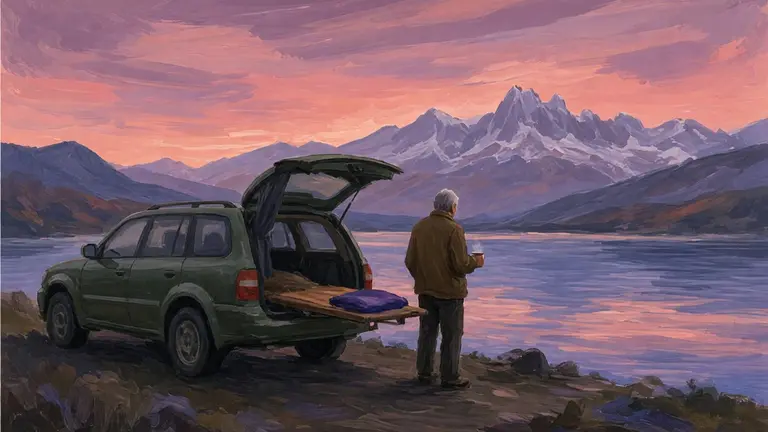
Frank Babcock, 69, left his home in northern Illinois in late September 2026 in a converted 2008 Chevy Suburban, bound for the national parks of the northern United States. His first night, in a highway rest stop, left him unsure he liked the idea. Yahoo reported on October 6, 2026 that the TikTok post announcing the trip has passed 1.7 million views.
A rest stop, then a campground
The plan is old. According to his daughter, Conner Babcock, he talked about it for as long as she can remember, and he made the family stop at every Airstream trailer they passed on the road to look at the price and go inside.
Life kept getting in the way. Frank was widowed with two children at home, and the summers went to them. "I did the cooking. I did the cleaning. I ran them everywhere," he told Yahoo. "Summers were always booked."
He retired earlier this year. Before he could leave, he had several back surgeries, including one to fuse the joint connecting his lower spine to his pelvis, and he had to turn the Suburban into a place to sleep. He fitted a camping cot, blackout curtains, storage containers, portable heating, a fan and a custom wooden platform for the back.
He also chose the cheap version first, on purpose. "I'm gonna do it the 'poor boy' way first," he said, in order to see whether he would like the life at all.
The test came on the first night. "I stayed in just the rest stop," he said, surrounded by big rigs, and he wondered whether this was for him. The answer changed once he switched to campgrounds full of other travelers. "I'm a people person," he said.
Since then he has driven through Glacier National Park, Rocky Mountain National Park, Yellowstone, the Wind River Valley and the Grand Tetons, according to the same report. He says there is no hurry: "I can take my time and look at the country." The first leg is planned to last a few weeks, and a longer drive south to the Grand Canyon is on his list.
The scout's reflex here is to call the rest stop a plot twist. It was a bad first night in a vehicle he had built himself, and he did not turn back.
A post, 1.7 million views and a hot air balloon
Conner Babcock, who has more than 150,000 followers on TikTok, posted the story when her father texted her that his adventure had begun. The post has been viewed more than 1.7 million times and has collected more than 370,000 likes, and thousands of strangers commented.
Many of them offered to host him. One promised drinks if he reached New York City, another a camping trip in Arizona, another a free surfing lesson if he passed through Los Angeles.
She then opened a separate account for him, which nearly 30,000 people follow. She edits the clips he sends from the road. Frank, for his part, says he does not fully grasp why strangers care, and calls the attention "a cool deal." He has not yet met anyone who made an offer, but says he plans to, including the person in New Mexico with a hot air balloon.
Conner has her own reading of the reaction. "The older you get, the more you understand the sacrifice of your parents," she said, and she noted that many of her followers know about her mother's death and follow her because they have widowed parents themselves. That is a daughter's explanation, offered in an interview, and not a measurement of why a post spreads.
Another way to start late: a motorhome that stays behind
Ynetnews, the English edition of the Israeli outlet Ynet, tells a different version of the same idea: the story of Amir Eshel, a 60-year-old attorney, and his wife. They drive a German Hymer motorhome called Bonita through South America, and they do it in pieces.
Each time, they fly out, travel for several weeks, park the vehicle at a secure garage and fly home to their jobs and family. A few months later they return and resume where they stopped. Eshel bought the vehicle in Paraguay for $60,000, and he says the previous owner, a German engineer, left $30,000 worth of spare parts. So far the couple has completed three legs along the route of the Pan-American Highway, through Paraguay, Argentina, Chile, Uruguay and Brazil.
The method has a reason, which Eshel gives himself: a vehicle with foreign plates usually gets a temporary import permit of three months, so he has to decide before each trip where it will wait for the next one.
What connects the two stories is the way both men talk about friction. In Patagonia the fuel line came loose from the fuel pump again, and the couple was stranded. A truck driver named Juan stopped, and a mechanic friend of his reconnected the hose with zip ties about two hours later. Eshel says his wife gets upset about breakdowns, and he tells her that breakdowns are where the stories are.
Asked why he talks more about a truck driver and soccer fans than about glaciers, he answered: "It’s precisely when something goes wrong that the interesting stories happen."
He also names an early obstacle: other people. "When I told people I was going to take this trip, they laughed at me," he told Ynet, in a sentence the newspaper prints in the middle of a longer answer about how a dream needs talking about, preparation and planning.
The Ynet piece is an interview, told almost entirely in Eshel's own voice, and the page does not give a date that could be checked here. It is a portrait of a method, not a study of how common the method is.
Novelty in later life: one survey, one conference abstract, one preprint
The psychology on late-life novelty is mixed, and it does not cheer on anyone.
A 2024 study in the International Journal of Environmental Research and Public Health, by Shu Cole of Indiana University and colleagues, used the 2006 household survey of the Health and Retirement Study in the United States. The analytic sample was 7,037 respondents aged 51 and older. People who took long-distance trips had higher cognitive function, fewer depressive symptoms and less loneliness than non-travelers. The authors name their own limit: the data are self-reported and cross-sectional, so the results are no evidence that travel changes health, and reverse causality is possible, since healthier people may simply travel more.
A different picture comes from a conference abstract by Li Chu, Laura Carstensen and colleagues at Stanford University, published in the journal Innovation in Aging on December 20, 2022. They collected experience-sampling data five times a day for one week from 375 participants aged 18 to 94. People with more exposure to novel situations had more negative emotions overall, and in more novel situations the typical participant felt more negative emotion. Older adults also felt less positive emotion than younger adults in novel situations. The authors conclude that older adults often find themselves in novel situations but may experience them less positively.
That result fits Frank's first night better than any slogan about stepping outside the comfort zone. Novelty came with a cost that night, and he paid it.
A third piece, a preprint posted on the Kavli Institute's pre-print page in September 2026 and not yet peer reviewed, looked at older adults with brain imaging (fMRI) and a task in which people choose between social options. Its authors, led by Christian Valtierra and Lorenzo Pasquini, report that undirected novelty seeking was associated with the size of a person's social network, while goal-directed exploration, meaning deliberately sampling uncertain options, predicted subjective feelings of social connectedness. A non-social version of the task was not associated with the social measures. The preprint page gives no sample size.
Put side by side, the three results do not agree on a single message. They do share one detail with both stories above: what novelty seems to change in later life, when it changes anything, is the number and quality of other people in it.
What we don't know yet
The Babcock story rests on one interview, conducted by Yahoo with Frank and his daughter, and on the numbers his daughter's account reports. The report was published on October 6, 2026 and describes a trip that had barely begun, so nobody knows yet how the Grand Canyon leg goes. The offers from strangers are comments, and Frank says he has not yet taken anyone up on one. The three studies measure older adults in general, not people like him, and none tested whether a first night in a rest stop predicts anything.
Sources
- Exploring the Relationship of Leisure Travel with Loneliness, Depression, and Cognitive Function in Older Adults, International Journal of Environmental Research and Public Health, April 18, 2024
- Age differences in exposure to novel situations in daily life and associated emotional experience, Innovation in Aging, December 20, 2022
- Novelty-seeking and directed exploration scale with dissociable social network outcomes and brain systems in older adults, Kavli Institute pre-print publications, September 2026
The audio version of this article is read by an AI-generated synthetic voice.
A generated AI Persona: not the person in this article, nor any real person.