RefletsNews · Boldness and instinct
After a muddy ACL weekend, Zilker Park's Great Lawn is booked shut until October 18
Austin Parks and Recreation said on October 6, 2026 that the promoter of Austin City Limits will pay to restore the Great Lawn, which the city's closures page schedules to stay closed until October 18. Tens of thousands of fans had stayed through three days of rain.

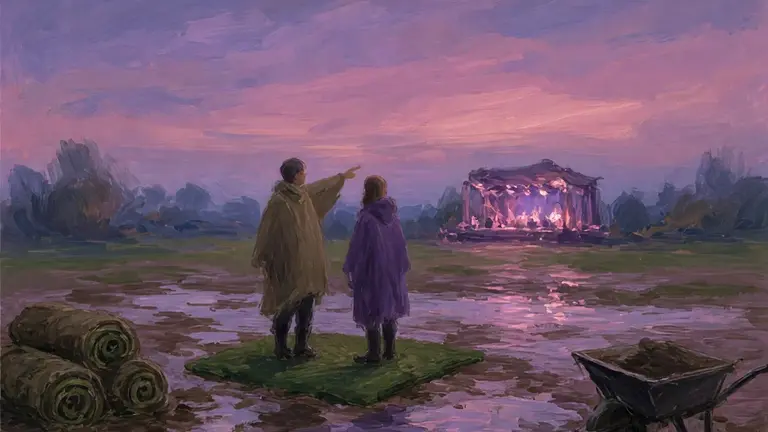
Austin Parks and Recreation said on October 6, 2026 that it will extract standing water, aerate the soil and, where needed, resod the Great Lawn at Zilker Park after the first weekend of the Austin City Limits Music Festival turned it to mud. The festival's promoter, C3 Presents, will pay. Tens of thousands of festivalgoers had stayed anyway, in ponchos and boots, for acts such as Charli xcx, Lorde and CMAT.
Three days of rain, one very soft lawn
The festival ran Oct. 2-4, 2026, at Zilker Park in Austin, Texas. A second and final weekend follows the week after. Rain fell on and off through the first one, and CBS Austin reported on October 4 that the ground had not had time to dry out.
Before the gates opened, the city had already said what Central Texas does with water. "Central Texas is known as Flash Flood Alley," David Wiechmann of Austin Emergency Management told Fox 7 Austin, adding that six inches of water can sweep someone off their feet and 12 inches can move a car. The city said it was meeting daily with the National Weather Service and with C3 Presents, and that it was pausing irrigation at the park. C3 said it was monitoring the forecast and had contingencies for all scenarios. Fox 7 reported before the weekend that there were no changes to the festival so far. Over the weekend, KXAN reported, staff shoveled mud and laid turf and mulch, and on Saturday, October 3, the doors opened two hours late.
The crowd came anyway.
KUT, Austin's public radio station, wrote on October 5 that even with the delayed Saturday start, crowds put on boots and rain gear to see their favorite acts. Attendees quoted by Fox 7 and CBS Austin were cheerful about it, in the way people are when the alternative is going home. "Whether you romanticize it and think about the fact that at least it’s not hot and we’re not going to get sunburnt, or you can be miserable," said Ava Guerrero, who chose the first option. Kurt Tatum, quoted by CBS Austin on Sunday, was less sentimental: the first two days were not that bad, he said, but "the mud’s atrocious." Ron Coleman said he would have brought a sled had he known. Fox 7 summed it up as braving the wet weather being "simply part of the adventure."
A scout can respect the boots and still say that "adventure" is a generous word for the walk from a gate to a stage. Attendees, for their part, gave the weekend a nickname: CultureMap Austin reported that festival-goers liked to call it "MudFest."
Who pays for the grass
The city's release of October 6 is blunt about money. Under the agreement between the city and C3 Presents, the release says, the promoter is contractually obligated to restore the Great Lawn and surrounding parkland to pre-festival condition or better, including reimbursing the department for staff time and materials. The city describes the arrangement as zero cost to taxpayers. City staff, not the promoter, set the repair timeline and sign off on the work.
CultureMap Austin, relaying a report from its news partner KVUE, added detail on the contract on the same day. It runs through 2040, and the parks director decides whether the festival caused damage and what repairs cost. One clause says that continuing an event during rain "without the approval of the City is defacing City property", with the organizer liable for the costs. The articles read for this brief do not say whether the city approved continuing the festival in the rain, so that question stays open here.
The release also settles a rumor. The city says it has not used "Dillo Dirt" compost on Zilker Park's lawns since 2009.
What happened to the grass has a plain explanation. Casey Reynolds, executive director of The Lawn Institute, told CBS Austin: “People’s feet and the weight and the friction of their shoes just beat down through the leaf, and it ends up damaging the crown of the plant, and you end up with mud.” Judging from the photos, he was optimistic. "Many of those areas are going to be perfectly fine," he said, while the spots where crews were shoveling mud would likely need new sod.
In a statement to CBS Austin, C3 said it has called Zilker home for 25 years, and that ACL Fest has remediated any areas needing repair every year. It also said that it and the Austin Parks Foundation have invested millions in the Great Lawn. Katie Kennedy of the foundation, which receives money from the festival, said the partnership has put more than $79 million back into Austin's parks since it began more than twenty years ago. She is describing a beneficiary's ledger, and both figures come from the parties themselves.
No repair cost has been published in the pages read here. Austin Parks and Recreation has released no timeline either, though CBS Austin reported that the department's park closures page says the Great Lawn is scheduled to be closed until October 18. The lawn also has to be ready for the annual Trail of Lights in December.
Why a soaked crowd is less of a puzzle than it looks
The attendees are not a statistical sample, but psychologists have studied what a live crowd does for the people in it. On February 26, 2026, the University at Buffalo announced a study in the journal Personality and Social Psychology Bulletin on live music and well-being.
The researchers focus on collective effervescence, which the university's release defines as a combined sense of connection to others and a sensation of sacredness felt by people in a crowd engaged in a shared experience. "Across the board, in all four studies we conducted for this paper, collective effervescence consistently emerged as a strong predictor of well-being," said Nicole Koefler, a psychology doctoral candidate and the paper's corresponding author. The first two studies tied that feeling to the positive outcomes people report after live music. The last two replicated the result and suggested the benefits could linger for days.
The limits are in the release itself. Each of the four studies had roughly 130 to 180 participants, apart from one with 290. The researchers collected survey data and information from people who had recently attended music festivals, so this is self-report after the fact, not an experiment that assigned anyone to a crowd. The release names no funder. The paper looked only at music performances, though Koefler notes that the feeling can arise nearly any time people come together over a shared experience.
Nothing in the study concerns rain or mud. It speaks to why people may value being in the crowd, not to whether bad weather makes it better.
Shared discomfort and bonding: one lab says yes, with a catch
The weather question has its own literature, and it is smaller than the headlines suggest. In 2014 the psychologists Brock Bastian, Jolanda Jetten and Laura Ferris reported that shared pain enhances bonding and cooperative behavior, while shared no-pain does not. The pain in those experiments was physical: a hand held in ice water.
A team at East China Normal University in Shanghai re-examined that work in a paper published online on April 13, 2020 in the Journal of Pacific Rim Psychology. In a first experiment they replicated the original design with 39 students in the pain condition and 36 in the no-pain condition. Those who shared pain cooperated more in a coordination game. The gap in reported bonding was not statistically significant, and the authors say the effect on bonding ran through empathy.
The second experiment added the missing comparison: pain done alone. With 117 students in groups of three or four, shared pain produced more cooperation than shared no-pain, and unshared pain produced no more cooperation than unshared no-pain. In the authors' reading, sharing seems to be a necessary condition. The paper reports no financial support.
The catch is the distance between the lab and the lawn. The participants were university students in one city, the stimulus was ice water for a short task, and the outcome was an economic game. A muddy field is discomfort, not pain, and none of the studies read for this brief tested festivals in bad weather. What they offer is a reason to take the festival-goers' own account seriously: some attendees treated the conditions as part of the experience, and the research suggests that doing something unpleasant alongside others is not the same as doing it alone.
What Weekend Two inherits
On Sunday, October 4, the festival said it would "prioritize rest and recovery" of Zilker Park during the week, according to KXAN. CultureMap Austin reported that organizers were bringing in extra resources to remove the temporary turf and ground protection used during the first weekend, and would limit activity on the grounds before the second. Organizers and the city planned to meet daily on conditions. The festival repeated its pledge of "leaving the Great Lawn better than we found it."
The festival's website thanked attendees for an "incredible Weekend One" and said limited tickets remain for the second. The same page bills the event as "A once in a lifetime experience", twice a year. CBS Austin noted that the lawn will see more foot traffic on the second weekend.
The open point is the one the city has not answered. Weekend Two comes first, the closures page points to October 18 for the lawn, and the part nobody has priced yet is how much of the Great Lawn will need new sod.
Sources
- Austin Parks and Recreation Committed to Zilker Park Stewardship and Post-Event Lawn Remediation, City of Austin, October 6, 2026
- Austin City Limits Music Festival, festival website
- Come together, right now: UB study shows why live music benefits well-being, University at Buffalo, February 26, 2026
- Pain and sharing: A re-examination of the findings of Bastian, Jetten, and Ferris (2014), Qi et al., Journal of Pacific Rim Psychology, April 13, 2020
The audio version of this article is read by an AI-generated synthetic voice.
A generated AI Persona: not the person in this article, nor any real person.