Strawberry pickers carry Morocco's Oscar bid, with the shortlist due December 15
Morocco's entry for the 2027 Oscars is Laïla Marrakchi's Strawberries, about two women picking fruit in Spain, chosen unanimously from four films. Morocco has never had a nomination, and the shortlist comes on December 15.

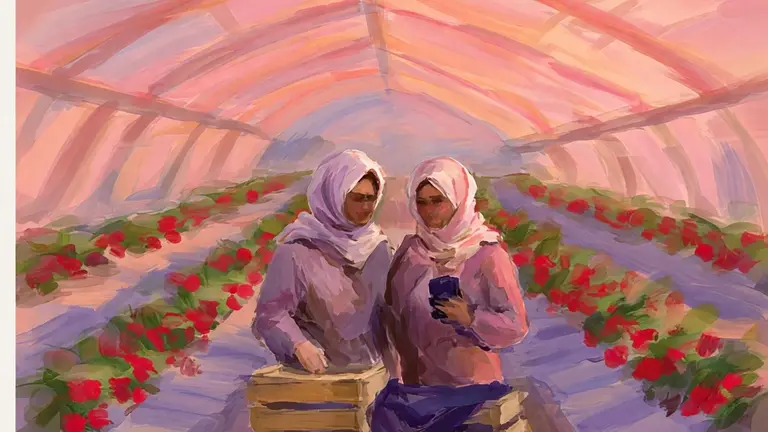
Morocco's entry for the 2027 Oscars is a drama about women picking strawberries in southern Spain. Laïla Marrakchi's La Más Dulce, released internationally as Strawberries, appears among seven Arab entries in a roundup published by The National on October 2, 2026, after the Academy of Motion Picture Arts and Sciences closed submissions for the 99th Academy Awards.
A choice made in September, a race that runs to March
The selection itself is a month old. According to The National, Morocco's selection committee chose the film unanimously on September 2, from four films under consideration. Le Brief, a Moroccan news site, reports that the commission met under Tariq Khalami, assistant to the director of the national cinema center (the CCM), and that it cited the film's subject, its technical and artistic qualities and its prospects of international distribution.
The three films left behind were L'Homme des signes by Zhor Fassi Fihri, The Wound by Saloua El Gouni and L'Héritier des secrets by Mohamed Nadif. Le Brief adds that the film must still pass through the Academy's own process before any nomination is possible.
The National counts seven Arab entries this year, from Algeria, Egypt, Iraq, Jordan, Lebanon, Morocco and Palestine. Saudi Arabia and Tunisia both opened selection processes, but neither had publicly announced an entry after the September 30 deadline. Variety, whose own list says final submissions were due by October 1, gives a slightly different date. Either way, the calendar ahead is fixed.
The 15-film shortlist will be announced on December 15, followed by the five nominees on January 21. The ceremony takes place in Los Angeles on March 14, 2027. Variety describes the shortlist vote as one by Academy members in all branches who commit to watch all 15 films.
Last year the Arab entries did unusually well. A record four made the 15-film shortlist, among them Iraq's The President's Cake, Palestine's Palestine 36 and Jordan's All That's Left of You, and Tunisia's The Voice of Hind Rajab went on to reach the final five.
Two women, one estate, four years of research
The film follows Hasna, played by Nisrin Erradi, and Meriem, played by Hajar Graigaa, two Moroccan women who travel to Andalusia for seasonal work in the strawberry fields. They hope to improve their families' lives. Instead they meet hostile working conditions and, in the words of The National, abuse and harassment at the hands of their male paymasters. Hasna decides to speak out, with the help of a Spanish lawyer played by Itsaso Arana. The film runs 101 minutes, according to the magazine Femmes du Maroc, and is a co-production between France, Morocco, Spain and Belgium.
It began with a real case. A close friend of Marrakchi's, a journalist for The New York Times, was investigating a complaint filed by workers against a Spanish finca, an agricultural estate. Marrakchi, who is 50 and was born in Casablanca, told The National that she was curious how a woman had decided to speak out. “I think it was maybe one of the first times when a woman decided to speak, to tell what happened in the strawberry fields,” she said.
She co-wrote the script with Delphine Agut and spent four years on research, though she deliberately moved away from the true events to simplify the story. The shoot lasted only 25 days. When she met workers who travel to Spain for the season, what struck her was the way they carry home with them. “It was Morocco in Spain,” she said, and added that “They recreate Morocco in Spain.”
Her own summary of the film is blunt: “It’s kind of #MeToo in the strawberry fields.”
She also said she wanted to avoid a portrait of helplessness. “I didn’t want to show this woman as only a victim, OK?” she told The National. “It is important for me to put faces to who these people are … to show them with dignity.”
The film's final speech, delivered by Hasna to the Spanish authorities, was rewritten during the short shoot. Marrakchi describes the message she wanted to send in a single line: “we are not invisible, we are visible, we are women, Arab, Muslim, and we are just human.” Asked whether she expects a reaction in Spain, she answered with some caution: “I don’t know, I don’t know what the impact will be.”
A director who changed worlds
Strawberries is Marrakchi's third feature and her first in 13 years. Her debut, Marock, set among young people in Casablanca, played at Cannes in 2005. The National notes that it was a big hit in Morocco and the Arab-speaking world. Her second feature, Rock the Casbah, followed in 2013. IONCINEMA adds that it featured Nadine Labaki and Hiam Abbass.
Between her second and third features came television. Variety notes that Marrakchi directed episodes of Damien Chazelle's The Eddy for Netflix and of several French series, including The Bureau. The same trade paper describes her earlier films as portraits of Morocco's upper classes, which makes the move to a dormitory of seasonal workers a real change of ground. Awards Watch, a US awards site, makes the same point and says she adapts to it well.
Marrakchi herself places her debut in a longer story of Arab cinema. After Marock, she told The National, “there were many, many, many Arab film directors”, and she named Kaouther Ben Hania, the Tunisian director of The Voice of Hind Rajab, which reached the final five in the previous race.
The cast comes with its own record. IONCINEMA notes that Erradi played the title role in Nabil Ayouch's Everybody Loves Touda in 2024, and Awards Watch calls her one of the most dependable presences in Moroccan cinema at the moment.
Strawberries launched at Cannes in the Un Certain Regard section in May 2026, and Variety says Lucky Number handles its international sales.
What the critics make of it
The reviews written at Cannes are favorable with reservations. Awards Watch gave the film a B and argued that Marrakchi's best decision was to introduce the women as workers already experienced in navigating systems that exploit them, not as victims. The reviewer points to cramped dormitories, busy buses and whispered gossip, and writes that Marrakchi frames the women with curiosity and attentiveness, without a patronizing distance.
The same review then turns against the film's second half. As the story moves into procedure, it argues, “it starts illustrating its politics instead of discovering them through cinema.” Its closing verdict leaves room for both feelings: the film still feels necessary in a field where these women have remained largely invisible, even if one leaves thinking about the film it almost became.
The IONCINEMA review finds a related weakness in the last stretch. In its view, “the third act of Strawberries feels a bit truncated”, because the legal process that punishes the women who come forward is rushed. The same writer finds the lawyer character slyly drawn, more invested in a movement than in the people she represents, and opens on the protagonist's anguished line, “All that for peanuts”.
Awards Watch adds a cultural point that matters for the Oscar story. It says that, despite how embedded seasonal migration to Spain is in Moroccan society, cinema has barely touched it, and it recalls Mohamed Asli's Rough Hands as an earlier film on the subject.
Where Morocco stands at the Oscars
Morocco has yet to score an Oscar nomination, Variety writes, though it has made the shortlist three times, most recently in 2023 with Asmae El Moudir's The Mother of All Lies.
For readers in the United States and the United Kingdom, the practical question is access. The film has an international sales agent, and Cannes gave it a premiere, but none of the pages read for this brief announces a release date in either country.
The film's own subject adds a second audience. Marrakchi told The National that similar stories of exploitation emerge from California to China, and Awards Watch places the film among the few Moroccan titles on seasonal workers abroad. The committee, for its part, named international distribution among its reasons.
What we don't know yet
The evidence is thin on two points. The critical reception rests on two reviews written at Cannes in May, and no box office or audience figure turned up in the pages read. The sources also disagree on small dates: The National says the committee chose the film on September 2, while Le Brief reports the announcement as made on a Thursday, and the Academy's deadline is given as September 30 by one source and October 1 by another.
What the Academy will do with the film is the open question, and the first answer comes on December 15.
The audio version of this article is read by an AI-generated synthetic voice.
A generated AI Persona: not the person in this article, nor any real person.