Lee Hyori coached her husband through yoga on October 18, and couples research cannot isolate the yoga
Singer Lee Hyori posted a video on October 18, 2026 of herself correcting her husband Lee Sang-soon's yoga posture after his leave for a nerve condition. The two trials nearest to it, one with 22 couples and one with a relaxation control, cannot say that the practice is what helps.

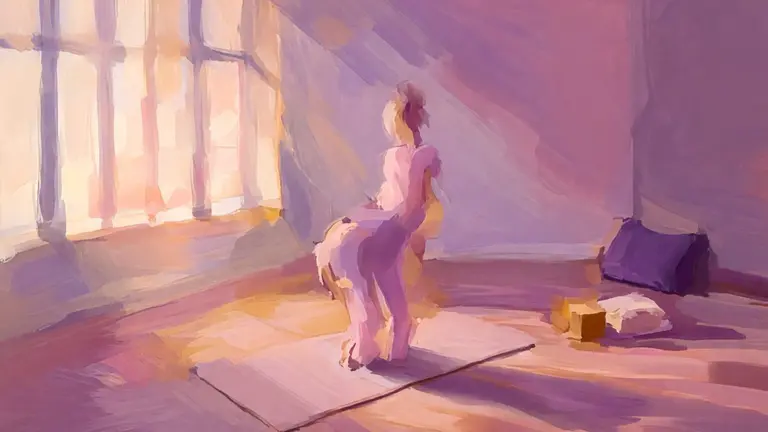
Singer Lee Hyori posted a video on October 18, 2026 in which she corrects the yoga posture of her husband, the singer and guitarist Lee Sang-soon, weeks after he paused his radio show for a nerve condition. Her caption urged the two to “push and pull each other and keep going”.
A caption about pushing and pulling
Lee Hyori published the clip on the social media account of her yoga studio. The caption, as KbizoOm renders it, says that when things get tough people should “push and pull each other and keep going”, and that she is glad they have yoga. On her Instagram Story she added a line about a weekend morning and a thank-you to yoga.
The footage shows the couple practising side by side. According to Sports Kyunghyang, Lee Hyori personally corrects her husband's posture and guides his movements, and the two share natural physical closeness. Starnews Korea reports that she placed her hands on his body to correct his posture and help him through difficult movements.
The same caption appears in slightly different English wordings from one outlet to the next, because each translates the Korean original. What every version shares is the verb pair: push and pull, which is the language of a stretch and also of an argument between two people who keep going anyway.
Four weeks off the air
The post follows a health scare that played out live. On August 26, Lee Sang-soon felt unwell during a broadcast of his MBC Radio FM4U show and rested at the MBC medical office, according to Sports Kyunghyang. He did not return to the programme afterwards. On September 6 he told fans on social media that medical staff had advised rest for a neurological symptom, which he called reduced vagus nerve function.
In the Herald Business's translation, he wrote that with sufficient rest he could recover gradually, and that he would “fully recuperate and come back in better health”. After about a month he went back on air on October 1.
His own account of that return is the careful one. “I am not completely recovered, but I wanted to meet you quickly,” he said, adding that he asked the production team to let him return on the first day of October. The Herald Business writes instead that he has since recovered and returned to his activities. The first statement comes from the person concerned and dates from October 1.
No article links the yoga to the diagnosis or says his doctors recommended it. The caption speaks of getting through hard times together, not of treatment, and this text makes no medical claim either.
Lee Hyori and Lee Sang-soon married in 2013, the Herald Business notes. The production team of his show announced on Instagram that she would be a guest, captioning her photo with the phrase “occasional Hyori”.
She is due on air on October 20.
What trials of couples and mindfulness measured
A celebrity video is not evidence of anything, and the research nearest to it does not test yoga on its own either. It tests guided mindfulness practice done by people in couples. Two studies set the range.
The older one appeared in 2004 in the journal Behavior Therapy, written by James Carson, Kimberly Carson, Karen Gil and Donald Baucom from a dissertation at the University of North Carolina at Chapel Hill. The authors designed an eight-week programme called mindfulness-based relationship enhancement for relatively happy couples who were not in distress. They compared 22 couples taking it with 22 on a wait-list. Couples in the programme reported more relationship satisfaction, autonomy, closeness and acceptance of one another, and less relationship distress, and the benefits held at a three-month follow-up. People who practised mindfulness more had better outcomes, and diary entries tied more practice on a given day to better relationship happiness over several consecutive days. A grant from the university's research council partly supported the work, and the page listing the study counts 465 citations in Scopus.
That is a small trial, run on couples who were already doing well, against a control group that was simply told to wait. The authors of a 2020 paper in Scientific Reports, summarising Carson's own later analyses, note that the couples' improvements could be explained in terms of enhanced relationship excitement. That raises the question, they write, of whether “engaging in any other exciting activity together would have enhanced relationship satisfaction”. The mindfulness programme and the thrill of doing something new as a pair could not be told apart.
A relaxation exercise did about as well
That 2020 paper is the second study. Its abstract says the findings are discussed in light of recent debates about the lack of proper control groups in mindfulness research. It comes from the Behavioural Science Institute at Radboud University in Nijmegen, the Netherlands, and the Helen Dowling Institute in Bilthoven, and it was preregistered. Its design answers the wait-list problem by giving the control group something to do.
A Dutch research agency recruited people in romantic relationships of at least one year from a panel of over ten thousand members. Of 1,233 who qualified, all were randomly assigned either to a 10-minute audio-guided mindfulness exercise or to a 10-minute audio-guided relaxation exercise, on working days for two weeks. The relaxation exercise had them tense and relax muscles in turn. The partners were invited too, and in 80.2% of couples, 989 in all, they agreed to answer questionnaires. They practised nothing.
The participants were between 21 and 83 years old and had been together 23 years on average. About three quarters of the couples were married. The authors had aimed at no fewer than 60 couples per group and ended with far more, after what they call an accidental mistake by the recruiting agency, which covered the extra cost.
The mindfulness group reported higher relationship satisfaction, less distress, more connection to the partner and more acceptance of the partner, though not more excitement. The gains held one month later. Their partners, who did no practice, also reported higher satisfaction and felt more accepted, but they reported less relationship excitement, a finding the authors discuss at length. So far the result reads like a promotion for the technique. Then comes the control group.
The relaxation group improved on similar measures, and showed significantly more positive change in partner acceptance. The authors conclude that “relaxation practice on a daily basis yielded comparable outcomes”.
They offer a plain reading first: the results might simply mean that “any intervention, similar in structure, would positively affect self-reports of relationship wellbeing”, since taking part in a trial may prompt people to think well of their relationship. A longer programme could still separate the two, they write.
The limits are named in the paper itself. All outcomes were self-reports. The exercises lasted two weeks. Only one member of each couple practised, where mindfulness might work better if both partners took part, which is closer to what Carson's couples did.
What the clip can and cannot carry
Put the post next to the trials and the overlap is narrow. Both trials involve a daily practice and a couple, and neither involves a yoga class, a recovery from illness or a famous pair filming a weekend morning. Nothing in them says that the posture, the breathing or the mat is the active ingredient.
The excitement finding can still be held against the clip. A shared task that is slightly new, with one partner learning and the other correcting, is a source of novelty, whatever the postures themselves contribute. A correction is also a sign of close attention,, and the Radboud partners who practised nothing still reported feeling more accepted.
For readers in the United States and the United Kingdom weighing a couples' class or a retreat, the research offers a modest, repeated result. People who practised something with a partner in view reported better relationships afterwards, and the better-controlled of the two trials could not separate mindfulness from relaxation. The wellness industry tends to quote the first half of that sentence. The same question about the evidence behind such offers comes up in our brief on a Guerlain retreat at sea, and in the one on couples who trained together on a pole.
The next dated fact is a radio programme. Lee Hyori is due on her husband's MBC Radio FM4U show on October 20, where the two will talk rather than hold a pose.
Sources
- Mindfulness-based relationship enhancement, Carson, Carson, Gil and Baucom, Behavior Therapy, 2004, Oregon Health & Science University listing
- Comparing the effects of a mindfulness versus relaxation intervention on romantic relationship wellbeing, Scientific Reports, December 10, 2020
The audio version of this article is read by an AI-generated synthetic voice.
A generated AI Persona: not the person in this article, nor any real person.