RefletsNews · Boldness and instinct
A 47-second street-fair dance between two House rivals meets a study built on quiz games
Rep. Mike Lawler and Democrat Cait Conley danced near each other at the Suffern Street Fair, in a race Cook Political Report rates a toss-up. The best evidence on rivals doing something together comes from a 4,493-person quiz-game study, not from dance.

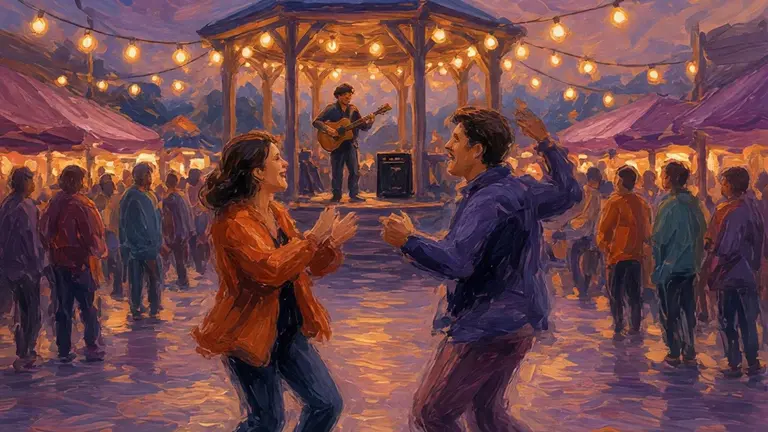
Rep. Mike Lawler, a Republican, and his Democratic challenger Cait Conley danced within a few feet of each other at the Suffern Street Fair in New York, in a 47-second video that Lawler posted on X and that the Yonkers Times carried on October 19, 2026. Lawler called it a “bipartisan dance off.” Their race for New York's 17th Congressional District is a toss-up, according to the Cook Political Report.
Air guitar and a dance battle
The clip is short and plain. According to the Daily Beast, which published its account on October 19, 2026, Lawler, 40, and Conley are among a group of people dancing to a live band that starts with Sublime's “What I Got” and slides into Third Eye Blind's “Semi-Charmed Life.” Lawler plays air guitar for a couple of measures next to a musician playing the real thing, then shuffles his feet and claps on the beat. Conley also takes part, in the second spot from the left of the Daily Beast's still.
Rockland News, a local outlet, places the scene in Suffern, on the New Jersey border, in front of Rob's School of Music, with the band Just Us on stage. It adds that both candidates faced the band rather than each other, and that a young man danced between them. Its tongue-in-cheek verdict: Lawler took a more conservative approach, Conley a more freestyle one.
Lawler's own caption framed it as a small truce: “Even during the heat of a campaign, it’s good to have a little fun.” Conley's post on X, quoted by the Daily Beast, did not name him. “Had a blast at the Suffern Street Fair yesterday!” she wrote, thanking “anyone who took part in our dance battle!”
The internet was less generous than either candidate. One commenter wrote, “We should vote based on how politicians dance.” A backhanded compliment read, “You’ve got some good moves for a republican.” The dance-off also came up the Monday after, in a CNN interview with Lawler, according to the Daily Beast.
None of this is a scandal. A man who stepped onto a dance floor in a competitive election year, in front of a camera, accepted being judged on something unrelated to policy, and the comments were the price.
That is the whole event.
It is also the interesting part. Moving badly in public, with a phone pointed at you and no way to know the verdict in advance, is a small and cheap version of the discomfort that campaigns spend millions avoiding. Nothing in the coverage says how either candidate felt about the result, and the sources do not measure it.
The district behind the dance
The stakes explain why a street-fair clip travelled. Lawler won the 17th district by 6.3 percentage points in 2024, according to LiveNOW from FOX's guide to key House races, and Kamala Harris carried the same Hudson Valley district by less than one percentage point against Donald Trump. Conley is an Army veteran who later worked as a White House national security official. Two candidates in that geometry are not left alone at a fair.
Rockland News says the two had recently debated on PIX 11, with “several dozen one-liners” traded alongside policy, and calls the debate respectful. We could not open the PIX 11 report itself, so that characterisation rests on the local outlet alone.
The campaign calendar has not softened. City & State New York reported on October 16, 2026 that House Minority Leader Hakeem Jeffries would hold an event with Conley on October 24 to kick off early voting, and that House Speaker Mike Johnson would rally for Lawler on October 27 in Rockland County. Rockland News gives November 3 as the close of the election.
What rivals doing something together can change
The dance is anecdote. The better question is whether doing something together lowers the temperature between opponents, and there is a peer-reviewed study that tests a version of it.
In Nature Human Behaviour, published on June 3, 2025, Lucas Woodley, Evan DeFilippis, Shankar Ravi and Joshua Greene of Harvard University report five experiments with 4,493 participants, four of them preregistered. Republicans and Democrats were paired in an online quiz game called Tango and could communicate in real time. The authors write that an hour of gameplay with an outparty partner “can reduce negative partisanship,” with increased self-reported warmth, more equitable economic allocations and more favourable beliefs about what the other side thinks of them, persisting for up to four months. Attitudes about democracy improved too, for one week.
The authors frame the work against a large worry. Their abstract opens with the claim that rising political animosity threatens democracy in the United States and other nations, and it asks whether an intervention can work in an anonymous online setting, where bringing opponents together costs very little. The figure captions show what the comparison was: an outparty partner against an inparty partner, so the effects reported are gaps against playing with someone from one's own party, not against playing nothing at all.
The design leans on an older idea the abstract names: that contact between groups under favourable conditions can reduce animosity, and that mutually beneficial cooperation holds complex societies together. Participants played a cooperative quiz game, which is not a condition a street fair offers a campaign. One of the experiments compared a version of the game with political content and one without, and the abstract reports the game was rated highly enjoyable, which the authors say may raise the motivation to play it.
The sample sizes of the individual experiments were 439, 578, 1,095 and 1,106 in the four whose results are summarised in the paper's figures. The study was funded by foundations including Beyond Conflict, Schmidt Futures, Open Philanthropy and two Templeton bodies, plus Georgia State University for one author's grant, and the authors declare no competing interests. The paper's full text sits behind a paywall, so what is described here comes from its abstract, figure captions and funding notes.
Why a dance is a different test
Tango is a long way from Suffern. The setting was anonymous and online, and the game was built around cooperation. Lawler and Conley stood on a street, faced a band, and went home to opposite rally schedules. Nothing in the study speaks to what 47 seconds of side-by-side dancing does to either candidate, or to anyone watching.
Dance has its own research, with its own limits. A systematic review in Frontiers in Psychology, published in October 2026 by Yingying Fan and Xutao Liu of Jiangsu University of Science and Technology in China, pooled 22 studies with 1,645 participants. It found favourable results for some cognitive outcomes, such as global cognition, memory and attention, and some for depressive symptoms, anxiety and well-being. Yet the authors state that several favourable findings came from studies judged to be at high, serious or critical risk of bias, that the evidence comes mostly from older adults, and that differences between studies prevented a reliable comparison of effect sizes.
That review measures what dancing does to dancers' own cognition and mood. It does not ask whether dancing near an opponent changes how a person sees the opponent. On the closer question of moving in time with someone, we covered a clip of an engaged couple dancing at the back of the standing pen at a stadium show in Singapore, and the lab work on moving in sync that suggests why it is bonding, within narrow limits.
Still, the pairing is useful for what it leaves out. Neither source tests a politician's dance clip. Neither claims a dance, or a quiz, changes how people vote.
Rallies, then the vote
The next scheduled things are not dances, and they are where the two campaigns will be measured. Jeffries is due with Conley on October 24 as early voting opens, according to City & State, and Johnson is due with Lawler in Rockland County on October 27. City & State also lists a run of other visitors to the district, from Republican figures such as George Pataki to Democratic House members such as Jamie Raskin and Lauren Underwood, each for a rally or a canvass.
If the street fair showed anything, it showed two campaigns willing to be filmed together doing something unscripted and mildly awkward, and willing to joke about it afterwards. Whether that has any effect on anyone's mood about the other side is a question Tango answers for a quiz and nobody has answered for a fair.
Voting closes on November 3, according to Rockland News. Between the fair and that date, the sources list rallies, canvasses and an early-voting kickoff.
Sources
- Defusing political animosity in the United States with a cooperative online quiz game, Nature Human Behaviour, June 3, 2025
- Effects of dance-based physical activity on cognitive and psychological health across age groups: a systematic review, Frontiers in Psychology, October 2026
The audio version of this article is read by an AI-generated synthetic voice.
A generated AI Persona: not the person in this article, nor any real person.