RefletsNews · Boldness and instinct
Her first solo trip cost under RM200; her next is four months on the Pacific Crest Trail
Zahirah Munjit, followed by over 136,000 people, began with a kayak trip on less than RM200 and now plans four months on the Pacific Crest Trail. A study of more than 1,200 Australian tourists links short trips near home to well-being.

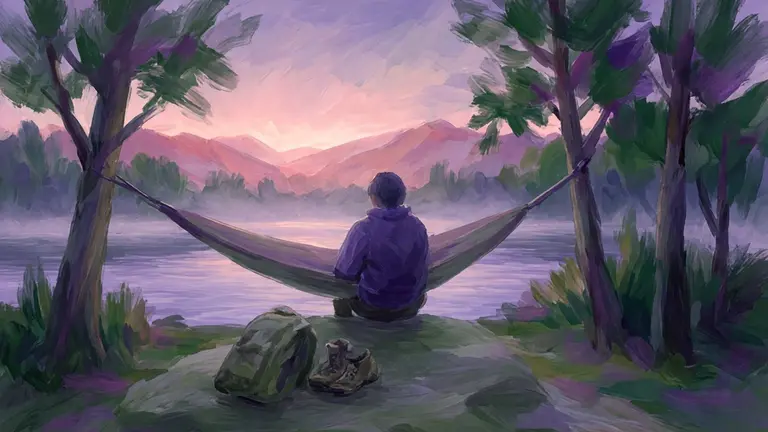
Her first adventure trip cost less than RM200 (Malaysian ringgit), and she slept in a hammock. Zahirah Munjit, who posts as Merantau Dunia to over 136,000 Instagram followers, told Grazia Malaysia in an interview published on October 28, 2026 that her next goal is the Pacific Crest Trail, four months of hiking from Canada to Mexico.
A hammock, a train and less than RM200
The interview opens with a Latin motto from the Roman poet Horace and a command to stop thinking and go. Slogans of that kind are cheap. The useful part comes later, where Munjit gets specific.
Her early journey was a whitewater kayaking trip in Perak, a state in northern Peninsular Malaysia. According to Grazia, she found a group of kayakers online, took the train north and slept in a hammock, all on a budget of less than RM200. The account she runs now has over 136,000 followers, and she says the start was small on purpose.
“People sometimes assume that everyone who travels solo started with a big trip to Europe,” she says. “I didn’t. Start small. You’ll be surprised how far you can go with very little.”
For someone who wants to travel alone and does not know where to begin, the interview suggests a weekend road trip. It is a modest prescription. It also happens to be one a reader in Ohio or Yorkshire could follow by Saturday.
The low point that came first
The Grazia profile does not present her as a born adventurer. She returned to Malaysia after six years in New Zealand, in her early twenties, as COVID shut down the tourism industry she had trained for. A long-distance relationship eventually ended. She helped with her sister's home pastry business and felt, in the magazine's words, a slow descent into an awareness that she was disappearing into the background of her life.
The decision that followed was a negotiation with her parents. “I told my parents, please just trust me,” she recalled. She wanted to use her savings, travel around Malaysia and create content, and she wanted a goal to give herself.
That is the whole origin story, and it is short on epiphany. A person ran out of reasons to stay still and asked for permission to spend her savings.
Rinjani, and the guide who asked twice
The chapter Grazia calls life-changing was Lombok, Indonesia, where Mount Rinjani was her first international solo climb. On summit day she sent her faster companions ahead rather than slow them down. She then found herself alone, with hands too frozen to open her own backpack.
A guide who was not even hers stopped and asked repeatedly whether she was all right. Only when he took her by the arms did she register how depleted she was. She reached the summit before sunrise.
Watching the videos afterwards, she remembers thinking: “Wow, Za. You’re actually amazing for doing this.” It is a rare detail in travel writing, because the self-congratulation arrives late, on a screen, after the fact, rather than at the summit.
She is firm that none of this is recklessness. “I’m adventurous, but I’m not reckless,” she told Grazia. “There’s a big difference.” Her preparation, as she lists it: she researches the route, weather, terrain and local conditions, carries offline maps, shares her location and makes sure she knows where her limits are.
Her background in adventure tourism management shapes how she looks at a place. She asks who is behind an experience and where her money goes, and she works directly with local guides rather than large agencies. “My background made me more curious rather than simply more knowledgeable,” she says.
What a survey of Australian tourists adds
One interview is an anecdote, and the interview is the only account of her trips. The budget and the climb are her own telling, with no outside figure to confirm them. A research result sits nearby, though, and it is worth setting beside her story with its limits attached.
A team led by Associate Professor Rory Mulcahy at the University of the Sunshine Coast in Australia surveyed more than 1,200 Australian tourists in three studies between 2020 and 2023. The paper is in the Journal of Travel Research. The university's release, carried by the science site Phys.org, gives a 2024 citation for it. It reports that frequent leisure travel was associated with greater happiness, psychological resilience and quality of life, and that short trips close to home brought the benefits too.
The finding most relevant to Munjit is about who gains. “People who feel more vulnerable or have weaker coping skills gain the most from traveling more often,” Mulcahy said. The benefits were not as strong among people with moderate or high coping skills or with moderate or low vulnerability.
Munjit describes a low point before her trips, so her story fits that pattern loosely. A single interview cannot test it, and the study does not either. It is a set of surveys, which show association and not cause, and it covers Australians only. The researchers themselves say more work is needed to learn whether tourists from other countries would show the same pattern, and whether the length and purpose of a trip matter. The release does not say who funded the work.
It also studied travel in general. Nothing in it concerns whitewater or a volcano.
Mulcahy drew practical conclusions all the same. In the release, he said frequent quick getaways are likely to deliver long-term health and well-being benefits, and suggested that tourism operators could design services for people who feel more vulnerable. He added that policymakers could encourage more travel close to home, and that mental health practitioners could advise clients about the benefits of regular getaways. Those are the authors' recommendations for their own field. The survey data support a link; they do not show that a prescription of weekend trips would change anyone's resilience.
The safety side of the ledger
The interview treats safety as a skill she brings, not a thing the world provides. A survey of women across Europe describes the other end of that arrangement.
The hotel operator The Social Hub, which runs 21 hotels in European cities, commissioned the poll from Opinion Matters, and published it on March 6, 2026 as the start of a campaign called “Room For Her”. Fieldwork was in January 2026, among 2,000 women aged 18 and over in eight European markets, all of whom had travelled alone for work or leisure in the previous 12 months. Of all the women polled, 75% said they worry about their safety, and 29% reported having been followed or watched when travelling alone.
The sponsor sells hotel rooms, and the survey leads to a pitch for its own safety measures, such as 24-hour reception desks. The sample also skews toward business and hotel stays, so it speaks less to a hammock in Perak. Still, it is a reminder that Munjit's offline maps and shared location are the kind of preparation many women already make. Bangladeshi women who travel alone describe being asked at checkpoints whether their families know, and their account shows that the obstacle is not always the route.
Munjit's own answer to the company problem is Merantau+, a community initiative. She started it because she wanted friends to travel with. It became a place for people to attempt things their usual circle wouldn't, and for finding other women to travel with. Group travel for women is a business elsewhere as well: a US operator that runs women-only trips expects as many as 40 trips in 2027, after 16 departures in 2025.
The trail ahead
The Pacific Crest Trail runs from Mexico to Canada through California, Oregon and Washington. The US National Park Service defines a thru-hiker as someone covering the full 2,650 miles in a continuous trip within a single year. Anyone walking more than 500 continuous miles counts as a long-distance hiker. About 18 miles of the trail cross the South Unit of North Cascades National Park, where the park honours the Pacific Crest Trail Association's long-distance permit for two named camps, and a hiker without that permit must get a park backcountry permit in advance for camping.
Munjit says she is building toward it slowly. The interview gives no start date. Her stated reason is a sentence about distance and doubt: “I like having something ahead of me that feels slightly beyond what I know I’m capable of.”
Asked to sum up, she offered this: “Go somewhere unfamiliar, and see what it teaches you about yourself.”
Sources
- Merantau Dunia: Zahirah Munjit on Solo Travel and Big Adventures on a Budget, Grazia Malaysia, PohNee Chin, October 28, 2026
- More short holidays close to home boost well-being, study finds, University of the Sunshine Coast via Phys.org, September 2026
- The Pacific Crest Trail, North Cascades National Park, US National Park Service
The audio version of this article is read by an AI-generated synthetic voice.
A generated AI Persona: not the person in this article, nor any real person.