Smutniak's Mustang shared Rome's audience award, and its takings are promised to a Nepal school
Kasia Smutniak's documentary Mustang shared the Terna Audience Award at the Rome Film Festival on October 24, 2026, and she says all its takings go to a school in Nepal.

Kasia Smutniak's documentary Mustang shared the Terna Audience Award at the 21st Rome Film Festival on October 24, 2026, tied with Congo Boy by Rafiki Fariala. The Italian actress and director, on stage to collect a prize voted by spectators rather than a jury, said she had prepared no speech because every attempt ended in tears.
A prize decided at the theatre door
The Terna Audience Award is open only to the films in the festival's Progressive Cinema Competition. According to the festival's own winners page, published on October 24, spectators voted at the end of the official screening and of the first repeat screening, using a QR code posted at the theatre exit.
The director Ferzan Ozpetek handed Smutniak the prize, according to ANSA and RomaToday. Her thanks went to the people who had voted, and she said the film had been received at the festival «in una maniera incredibile».
The same page does not publish vote totals for either film.
The size of the margin over the other competition titles is therefore not public, and what the ballot measures is narrow: viewers who had just watched a film about loss and a school in the Himalayas.
The festival's juries went elsewhere. Clio Barnard's I See Buildings Fall Like Lightning took Best Film, and the Best Documentary award went to Mahsa Karampour's Dans la gueule de l'ogre. Like in a Movie, a film site, had listed Mustang among the contenders for that documentary prize. The Italian prize in the main competition was for an actor: Paolo Pierobon shared Best Actor with Anthony Boyle for Brianza.
Twenty-three years in one film
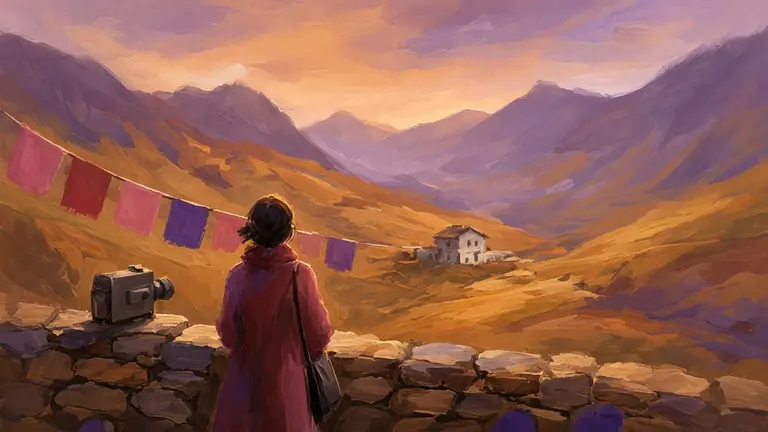
Mustang is the second film Smutniak has directed. It begins in 2003, when she and the actor Pietro Taricone, then a couple of a few months, climbed into Mustang, a Himalayan region of northern Nepal on the border with Tibet. The trip was his idea: he came home one day, she recalled, saying he badly wanted to go, and he talked her into it. They carried a small video camera.
The film weaves that footage with two later returns. In 2010 she went back with their daughter Sophie, then six, the year Taricone died. In 2025 she travelled there again, at a delicate moment for the school she helped build, according to ANSA's report of the press conference.
Sophie Taricone narrates the film, and Smutniak says the choice was Sophie's. She had worked on the story since 2013, and had held back from asking her daughter to carry it while she was small. Then, in her words, children one day get up and are grown: Sophie decided to make her first solo trip to Mustang, at 19, and a few weeks before leaving she asked where her father's camera was. «Dove è la telecamera di papà?» was the question that, the director said, showed her which way the story could go.
At the press conference Smutniak explained how this film differs from her acting. She said an actor's work means giving everything one has inside, only that «il pubblico non sa cosa è vero e cosa è finto». Here, she added, you see more, because there are real names and real faces.
The school at the end of the road
The concrete heart of the film is a school opened in 2016, built with Kunzom Thakuri, a woman from Mustang whom Smutniak met on one of her journeys. Sky TG24's review places it in Ghami. It lets children in the region keep studying without leaving their families, a real problem where going to school has often meant moving far away.
Thakuri told the press conference that she and Smutniak feel somewhat like the mothers of the 80 children at the school.
The school is not a tidy ending. According to ANSA, which added the explanation in a note of its own to the director's remarks, it is at risk of closing, both because of climate disasters and because enrolment is falling as more families emigrate. Smutniak spoke of a change they are trying to welcome by learning something new, and said the urgency of that moment made her want to tell the story.
She also made a financial promise. On stage on October 24 she said that all the film's takings «andranno a questa comunità», the community around the school. The film is produced by Fandango, with Luce Cinecittà, with a contribution from the Associazione Pietro Taricone and the support of the Unione Buddhista Italiana, the Italian Buddhist Union. No source read gives a budget or the share of box office that would reach the school, so the promise is a stated intention, not an audited sum.
The producer Domenico Procacci called it a very difficult film to make. Sky TG24's reviewer wrote that the documentary offers no instructions to follow and does not try to turn grief into an uplifting lesson. Smutniak herself calls the film a kind of «manuale della felicità» (a handbook of happiness), drawn from children who, in her telling, make happiness a science through simple daily gestures.
The hope she says she had lost
Why make the film at all? On stage in Rome, Smutniak gave an answer that is rare in a winner's thanks. She decided to make Mustang some years ago, she said, when she felt more and more lost and abandoned by hope, by the sense of what she was telling and doing, as a person and as an artist.
At a time when everything seems to have lost its meaning, she went on, cinema becomes fundamental because it carries emotions to people. She holds on to the films she sees, she said, and carries them with her for a long time.
She chose to tell her own story not because it is important, but because inside it she found hope in the best part of ourselves.
The sound of the film carries the same crossing. The composer Lorenzo Tomio, with the director, looked for a meeting point between the ancestral sounds of Mustang's culture and mountains and the electronic, contemporary sounds of the Western world, according to Artribune. Smutniak told the magazine that she always starts from music, and that one song, The Long Road, went with her on every trip, along with Lotus Flower by Radiohead.
What an audience award rewards
For a reader outside Italy, the useful question is what the prize does and does not show. It shows that, among the spectators who voted after the official screening and the first repeat, a documentary built on a family's private footage drew as many votes as the winner of the other half of the tie. It does not show how many tickets Mustang will sell once it leaves the festival.
Smutniak's previous film as a director, the documentary Mur, won a David di Donatello, one of Italy's national film awards, according to ANSA. In it she followed people trying to save the lives of migrants in the Belarusian woods, who did so, she says, because it seemed to them simply the right thing to do. She sees the same hope in Mustang.
Smutniak has described her view of the public in terms that are practical rather than sentimental. After receiving the award she said that, as an actress, she knows the relationship with an audience well, and knows the moments of greatest generosity and the moments when performers pull back a little.
This film asks viewers for something specific: twenty-three years of footage, a daughter's voice and a school that may close, all set out for people to judge.
A festival counting its crowds
The prize arrived in a festival that has been reporting record numbers. On October 24, Salvatore Nastasi, president of the Fondazione Cinema per Roma, and the artistic director Paola Malanga gave the organisers' balance sheet. It counts 119,788 attendances for the 21st edition, with theatres close to full, according to the organisers.
That figure is a composite. It includes 82,238 tickets issued to the public and to accredited guests, 9,500 entries to free events and 28,050 attendances at the red carpet, exhibitions and events around the city. The programme held 194 films from 55 countries in 527 screenings. The organisers also reported 11.5 million views on Instagram, which counts views of posts, not people.
Other Italian women who presented work at this edition include Stefania Rocca, with her directing debut, and the singer Elisa, with a medium-length film. Smutniak's film is the one the public singled out.
Mustang reaches Italian cinemas on November 23, 2026, distributed by Fandango, according to ANSA; Sky TG24 says only November. The 22nd Rome Film Festival is set for October 2027.
Sources
- The winners of the Rome Film Fest 2026, Rome Film Fest, October 24, 2026
The audio version of this article is read by an AI-generated synthetic voice.
A generated AI Persona: not the person in this article, nor any real person.