
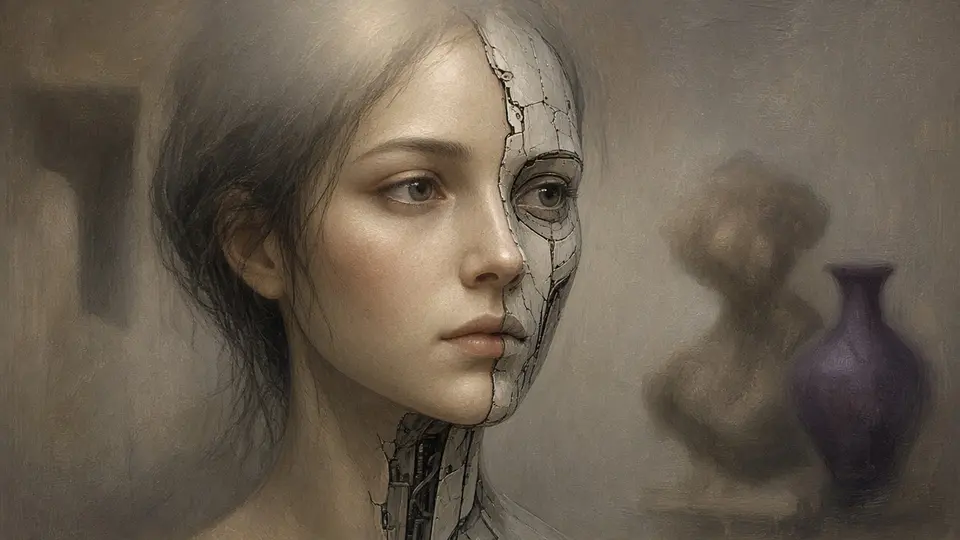
In 2006, Japanese researcher Hiroshi Ishiguro introduced the world to his double. The Geminoid HI-1, developed with the company Kokoro, replicated his face, furrowed brows and hairstyle. It was made from silicone rubber, pneumatic actuators, and hair taken from his own head. Faced with this machine, it is hard not to feel a mixture of fascination and unease. You want to look, yet you also want to step back.
This unease has had a name for over half a century: the uncanny valley. And it says something profound, not about robots, but about us.
In brief
- 1970: Japanese roboticist Masahiro Mori describes the “uncanny valley” in a short essay
- The idea: The more a robot resembles a human, the more we like it — until, when it is almost perfect, it becomes disturbing
- What science says: The effect is real but only appears under certain conditions; a meta-analysis of 72 studies deems it significant and reliable
- The best current explanation: The mismatch between human and non-human traits
- The twist: Since 2022, AI-generated faces have been judged more trustworthy — and even more human — than real faces
- What it reveals: Our brain is a machine for recognising the human, and it is the “almost human” that unsettles it
Before Mori: the uncanny
The unease felt in the presence of a machine that is almost alive did not begin with robotics. It first belonged to literature and psychology.
In 1906, German psychiatrist Ernst Jentsch published a short paper, “On the Psychology of the Uncanny”. For him, this disturbance arises from intellectual uncertainty: not knowing whether what is in front of us is alive or inanimate. He noted that one of the most effective techniques writers use to create this effect is to leave the reader in doubt: is this character a human or an automaton?
He cited in particular E.T.A. Hoffmann’s 1816 tale “The Sandman”. The hero, Nathanael, falls in love with Olympia, a young woman he watches at her window, only to discover she is a mechanical doll built by a scientist. Nearly two centuries before androids, literature had already imagined a man falling for a machine.
In 1919, Sigmund Freud took up the theme in his famous essay “Das Unheimliche”, usually translated into French as “L’Inquiétante Étrangeté” (“The Uncanny”). He too reread Hoffmann’s tale but shifted the question. For Freud, the uncanny is not merely the uncertain: it is the familiar returning in a disturbing form, something known but repressed that resurfaces where it is not expected. The German word says it all: unheimlich, the opposite of heimlich, which means both familiar and intimate.
These two readings anticipated, by sixty years, two of the hypotheses science is exploring today: categorical uncertainty (Jentsch) and the familiar become alien (Freud). When Mori drew his curve in 1970, he gave graphic form to a disturbance that Europe had already named.
A three-page essay that crossed the century
It all began with a very short text. In 1970, robotics professor Masahiro Mori published a few-page essay in a Japanese journal called Energy: “Bukimi no tani”, the valley of the uncanny. In it, he drew a simple curve. On the horizontal axis: resemblance to a human being. On the vertical axis: what Mori called shinwakan, a difficult-to-translate word lying somewhere between affinity and familiarity.
At first the curve rises. An industrial robot that looks nothing like a human inspires no particular affection. A toy robot with a head and arms is already more likeable. As resemblance increases, so does affinity. Then, suddenly, the curve plunges. Just before perfect resemblance lies a dip: the valley. At the bottom, Mori placed the corpse, then the undead.


His most famous example is that of the artificial hand. A realistic prosthesis can fool the eye. But when you shake it, Mori wrote, you may be struck by “its soft, boneless grip”, its texture and coldness. The illusion shatters, and with it the sense of familiarity: what seemed alive proves not to be.
Mori added an observation he considered decisive: movement amplifies everything. It deepens the valleys and raises the peaks. An almost-human face that is still is disturbing; the same face moving slightly awkwardly is even more so.
For decades, the essay circulated in the West in an approximate translation. It was not until 2012 that an English translation authorised by Mori, by Karl MacDorman and Norri Kageki, appeared in an IEEE journal. MacDorman explained that he had wanted to correct a version that had become a reference despite its errors.
What science has confirmed
For a long time, the uncanny valley remained more of an intuition than a proven theory. Experiments have multiplied since, sometimes with contradictory results, but an overall picture has emerged.
In 2016, in the journal Cognition, Maya Mathur and David Reichling tackled the problem at its root: instead of retouched laboratory images, they presented participants with 80 real robot faces. The dip appeared in likeability judgements, exactly as Mori predicted. They also observed that the deeper a face lay in the valley, the longer participants took to decide whether it was human or not. The hesitation itself seems to be part of the unease. Their results further suggest that the valley may subtly influence the trust placed in a robot.
The phenomenon may not even be unique to our species. In 2009, in the Proceedings of the National Academy of Sciences, Shawn Steckenfinger and Asif Ghazanfar showed five macaques images of their own kind: real monkey faces, realistic synthetic faces, and clearly artificial ones. The monkeys looked longer at the real faces and the obviously fake ones than at the realistic synthetic faces. Like us, they seemed to avoid the “almost real”. The authors see this as evidence of an evolutionary origin.
In 2021, a meta-analysis published in ACM Transactions on Human-Robot Interaction by Alexander Diel, Sarah Weigelt and Karl MacDorman reviewed the entire field. Of 468 studies examined, 72 met their criteria. Their conclusion: the uncanny valley effect is significant and reliable. But its best explanation is not necessarily the one most people assume.
A more fragile concept than it seems
This success nevertheless conceals a more nuanced story. In 2015, a team from Aalto University in Finland led by Jari Kätsyri reviewed all available studies in Frontiers in Psychology. Their verdict was harsh on the simplest version of the idea. Mori’s “naive” curve, in which affinity plunges as soon as one approaches perfect resemblance, was not consistently supported. Nor was the amplifying effect of movement that Mori considered decisive.
In other words, the uncanny valley is not a universal law that strikes every near-human object. It only appears under certain conditions. What the review did confirm, however, was a more precise lead: the mismatch when some facial traits are very human and others are not. This is the same lead that the 2021 meta-analysis retained as the most robust.
The story of the uncanny valley is therefore also that of a brilliant intuition, refined by fifty years of research. Mori was right about the essential — the unease of the almost-human — without being correct on every detail of his curve.
Why our brain panics
Several hypotheses compete, and they are not mutually exclusive.
Fear of death. Mori himself saw it as “an integral part of our self-preservation instinct”. Something that looks human but lacks life evokes the corpse, disease, danger. The unease would be a very ancient alarm signal.
Prediction error. In 2012, Ayse Pinar Saygin’s team observed via brain imaging participants watching three videos: a human being, an obviously mechanical robot, and the Japanese android Repliee Q2, which looks like a person but moves like a machine. The brain areas involved in perceiving others’ actions reacted differently to the android. The researchers see a prediction error: the brain expects a human-looking body to move in a human way, and the contradiction puts it in difficulty. It is exactly Mori’s boneless hand, translated into neuroscience.


The mismatch. This is the explanation the 2021 meta-analysis considers most solid: unease arises when, in the same face, very human traits coexist with non-human ones. Perfect skin and lifeless eyes. A correct smile and a fixed gaze. It is not the artificial that disturbs: it is the inconsistency.
The mind we attribute to the machine. The most troubling explanation comes from Kurt Gray and Daniel Wegner, published in 2012 in Cognition under the memorable title “Feeling Robots and Human Zombies”. According to them, a robot becomes uncanny when its appearance leads us to attribute experience to it — that is, the capacity to feel — rather than mere agency. In their experiments, a machine described as capable of feeling created unease even without a human face. Conversely, a human described as incapable of feeling also became disturbing. The authors conclude that we consider the capacity to feel as what is fundamentally human, and what machines fundamentally lack.
Hiroshi Ishiguro’s doubles
Few researchers have explored this territory as deeply as Hiroshi Ishiguro, professor at Osaka University. After his first Geminoid, he built five generations, all in his own image: dark hair, furrowed brows, glasses, black clothing. These machines reproduce his voice, head movements and some of his expressions, controlled remotely. They are not products: they are research instruments to understand what makes us feel we are in someone’s presence.


His androids have also met the general public. At Miraikan, Tokyo’s National Museum of Emerging Science and Innovation, two of them — Kodomoroid, who looks like a child, and Otonaroid, who looks like an adult woman — served as presenters and scientific mediators. Visitors could watch them, talk to them, and experience the same mixture of wonder and unease that Mori had described more than forty years earlier.
There is an irony in this story. Japan, which gave birth to the idea of the uncanny valley, is also one of the countries that has worked hardest to cross it.
Three centuries of automata
Long before androids, engineers sought to imitate life, and the public flocked to see the results.
In France in 1739, Jacques de Vaucanson presented his famous “digesting duck”. The mechanical bird appeared to swallow grain, digest it and excrete it like a real duck. In reality it digested nothing: the food was stored in one compartment and the “droppings” pre-prepared in another. The wonder was a sleight of hand, yet it fascinated all of Europe. Already, imitating life was as much about mechanics as illusion.
In Switzerland, between 1768 and 1774, clockmaker Pierre Jaquet-Droz, his son Henri-Louis and Jean-Frédéric Leschot built three child-shaped automata: a musician, a draughtsman and a writer. The Writer, powered by a mechanism of some 6,000 parts, dips its quill in ink and can write any text of up to forty letters thanks to a programmable mechanical memory. It is often presented as a distant ancestor of the computer. All three automata still work today and are on display at the Musée d’art et d’histoire in Neuchâtel.


In Japan during the Edo period (1603–1868), karakuri ningyō — mechanical wooden dolls powered without electricity by springs, gears and cams — developed. The most famous is the tea-serving doll, the chahakobi ningyō. When a cup is placed on its tray, it bows and moves towards the guest. When the cup is removed, it stops; when the empty cup is replaced, it turns around and returns to its place. In 1796, engineer Hosokawa Hanzō Yorinao published its secrets in an illustrated treatise, the Karakuri zui.
These automata share something instructive. None tried to pass for human: their faces were those of dolls, their gestures graceful but mechanical, and that is precisely what delighted people. Without knowing it, their creators had stopped at the first peak of Mori’s curve. The wonder came from the contrast between a clearly artificial object and a surprisingly lifelike gesture, not from perfect illusion.
Hollywood at the bottom of the valley
Animation cinema learned about the uncanny valley the hard way. In 2004, The Polar Express, directed by Robert Zemeckis using motion capture, was widely criticised for the empty, disturbing look in its characters’ eyes. The technology captured the actors’ gestures but not yet the micro-movements of the eyes: the children in the film had everything human except what makes a gaze alive. It was the mismatch in its purest form.
Three years earlier, Final Fantasy: The Spirits Within, produced by the Japanese company Square, had attempted total photorealism. With a budget of $137 million, it grossed only about $85 million worldwide and remains one of cinema’s heaviest commercial failures. Its spectacular but strangely cold rendering is often cited among the reasons for its rejection, though a box-office failure always has multiple causes.
The lesson was not lost. Much subsequent successful animation cinema has chosen clearly stylised characters with large eyes and exaggerated proportions. As if the industry had, without saying so, followed Mori’s advice.
How creators avoid it
For those who create characters — whether for robots, animated films or video games — the uncanny valley is not a theory: it is a production risk. Several strategies have become established, often learned the hard way.
Stylisation. This is the oldest and safest solution. Pixar learned this early on. In Tin Toy, their 1988 short that earned them their first Oscar, the studio featured a human baby named Billy. Cute on paper, he looked somewhat grotesque once modelled in 3D, team members later admitted. When Toy Story came along in 1995, the toys became the heroes and humans were relegated to the background. Since then, human characters in major animation studios have almost all been stylised: larger heads, enlarged eyes, exaggerated proportions. The viewer does not compare them to real humans, and the unease never triggers.
Embracing artificiality. This is the choice made by Ameca: near-perfect expressions, but a grey face that makes no attempt to look like skin. By clearly showing it is a machine, the categorical uncertainty — the “alive or not?” doubt that Jentsch described in 1906 — is removed.
Deliberately exaggerating a feature. For Alita: Battle Angel (2019), Weta gave the cyborg heroine much larger eyes than a human’s, faithful to the original manga. The choice divided audiences: some found it disturbing from the first trailer, others praised eyes of rare expressiveness. It is a way of exiting the valley sideways: by making the difference obvious rather than hiding it.
Perfecting the eyes and micro-movements. When realism is the goal, this is where everything is decided. The Polar Express failed largely because of the gaze. Game engine developers have since devoted entire demonstrations to “digital humans”, such as Unity’s The Heretic and Enemies, or Epic Games’ MetaHuman tool, focusing first on skin, hair and especially the eye: moisture, reflections, tiny involuntary movements.
Maintaining consistency. This is the direct lesson from research on mismatch: better a modestly realistic but coherent character than a hyper-realistic face that moves awkwardly. A human voice on a robot body, perfect skin on stiff animation: it is the juxtaposition that drops you into the valley, not the level of detail itself.
Avoiding faces altogether. Finally, many digital assistants have simply given up on the body: a voice, text, an icon. It is the most radical way never to enter the valley.
Sophia, Ameca: today’s faces of the valley
In the 21st century, two robots have embodied the debate in the eyes of the general public.
The first is Sophia, developed by Hong Kong-based Hanson Robotics. With a realistic skin-like face and, according to its creators, the ability to imitate 62 human expressions, it appeared on television programmes around the world. On 25 October 2017, Saudi Arabia granted it citizenship — a first for a machine. Many saw it as a publicity stunt rather than a legal breakthrough. But the episode says something about our relationship with these machines: a human face is enough for us to speak of them as someone.

.jpg)
The second is Ameca, created in 2021 by the British company Engineered Arts in Falmouth, Cornwall, and presented at CES Las Vegas in 2022. Its facial expressions, built from scans of real faces, are among the most human ever produced by a robot. Yet its creators made a striking choice: grey skin that is clearly artificial, and a deliberately genderless appearance. Ameca moves like a human but does not pretend to be one. Videos of its facial expressions have both fascinated and disturbed viewers, as if the robot were deliberately standing at the edge of the valley.


Resurrecting the dead
At the bottom of the valley, Mori placed the corpse and the undead. Fifty years later, artificial intelligence can make the dead speak, and the uncanny valley has found its most sensitive ground.
In France, the most striking example came from television. On 2 May 2022, France 3 broadcast the first episode of L’Hôtel du temps, a programme by Thierry Ardisson in which the host “interviews” deceased celebrities. For the first episode it was Dalida who answered him, in a sitting room at the Hôtel Meurice. An actress played the scene, and the French studio Mac Guff replaced her face with that of the singer, reconstructed by AI from archive images. The result fascinated as much as it disturbed. Some critics praised the technical feat, others pointed to the lack of naturalness in the exchanges. The problem was no longer the face: it was the mismatch between an almost perfect face and a conversation that was not.
Since then the technique has become democratised. Companies offer to create, from messages, photos and recordings of a deceased person, a conversational avatar that imitates their way of speaking. In 2024, two researchers from the Leverhulme Centre for the Future of Intelligence at the University of Cambridge, Tomasz Hollanek and Katarzyna Nowaczyk-Basińska, published an analysis of these “deadbots” or “griefbots” in the journal Philosophy & Technology. They describe worrying scenarios: an avatar of a deceased parent used to slip in advertisements, a child confronted with a simulation of their mother, loved ones unable to “switch off” a digital deceased. They recommend safeguards to protect the dignity of the dead and the consent of the living.
These uses show something Mori had not envisaged. The unease of the valley is not only visual. Faced with a recreated loved one, what disturbs first is not the skin or the gaze, but recognising a voice, a turn of phrase, a way of joking, while knowing that no one is there.
What if we have already crossed the valley?
The most recent twist has come not from robots but from images.
In 2022, in the Proceedings of the National Academy of Sciences, Sophie Nightingale and Hany Farid showed 315 participants 128 faces, some photographed, others generated by artificial intelligence. The result: participants correctly identified the faces only 48.2% of the time — chance level. Even more troubling, the artificial faces were judged 7.7% more trustworthy than the real ones. The authors state it plainly: image generators have crossed the uncanny valley.
The following year, in Psychological Science, a team led by Elizabeth Miller went further. AI-generated white faces were judged human more often than real human faces, a phenomenon they called “AI hyperrealism”. The effect did not appear for other ethnicities, which the researchers attribute to biases in the algorithms’ training data. And there was an additional paradox: the participants who were most wrong were also the most confident in their judgements.
These results overturn Mori’s perspective. The valley was not a wall; it was a passage. And on the other side there is no relief: there is the possibility of being deceived without knowing it. As long as the machine was imperfect, our unease protected us. When it becomes perfect, our human detector, however fine-tuned, can be disarmed — and may even prefer the copy.
What it reveals about us
The uncanny valley is often presented as a design problem: how to make robots that do not make us uncomfortable. It is first and foremost a discovery about ourselves.
It reveals above all that our brain is a machine for recognising the human, with formidable precision. We do not realise how constantly we read faces, gazes, the way a body moves. It takes only a micro-mismatch — a blink that is too slow, a hand that is too limp — for the alarm to sound. Robots show us, through their flaws, the extent of a skill we exercise without knowing it.
It also reveals that the almost-human disturbs us more than the obviously artificial. A robot vacuum cleaner does not worry us. A cartoon character moves us. It is when the machine pretends to take our place without quite succeeding that the disturbance arises. As if we were defending a boundary.
And the work of Gray and Wegner suggests that this boundary is not that of the face, but that of feeling. What we reserve for humans is not intelligence or action: it is the capacity to experience. A machine that seems to feel worries us; a human who seems to feel nothing does too. The uncanny valley outlines, in negative, our intimate definition of what it is to be human.
Mori ended his essay on this note. Thanks to robotics research, he wrote, “we can understand what makes us human”.
And what about artificial companions?
Mori’s practical lesson was clear. Rather than risk falling into the valley by aiming for perfect resemblance, he advised designers to aim for the first peak: a partial, acknowledged resemblance that elicits affinity without claiming illusion. He even cited as an example the bunraku puppet from Japanese puppet theatre: a clearly artificial face, but movements so expressive that the audience becomes deeply attached.
This recommendation resonates today far beyond robots. AI companions, avatars and voice assistants face the same question: should they perfectly imitate the human, or acknowledge that they are something else? Many designers choose stylised faces, drawn characters, or voice alone, as if to remain on the first peak.
But the uncanny valley may not only concern faces. If the best explanation is the mismatch between what seems human and what is not, then a conversation can also fall into the dip: a perfectly correct answer followed by a strange lapse, flawless empathy that suddenly rings hollow. It is no longer the eye that detects the inconsistency, but the relationship.
Research has begun to explore this avenue. In 2017, in the journal Cognition, German psychologists Jan-Philipp Stein and Peter Ohler had participants watch, in virtual reality, a conversation between two digital characters who expressed emotions and seemed to understand each other. Everyone saw exactly the same scene. The only thing that changed was what they had been told: whether the characters were controlled by humans or by artificial intelligence, and whether their dialogue was pre-written or spontaneous. When participants believed they were witnessing empathy produced autonomously by a machine, they found the scene significantly more disturbing. The authors speak of an “uncanny valley of the mind”: what disturbs is no longer the machine’s appearance, but the idea that it might feel and understand. This line of research directly echoes the work of Gray and Wegner and is of primary concern to today’s conversational companions.
Frequently asked questions
What is the uncanny valley in one sentence?
It is the unease we feel when faced with a robot, a synthetic character or an artificial face that looks almost, but not quite, like a human being. The idea was formulated in 1970 by Japanese roboticist Masahiro Mori under the name bukimi no tani. In French it is also called “vallée dérangeante”.
Is the uncanny valley scientifically proven?
Partially. A 2021 meta-analysis of 72 studies concludes that the effect is significant and reliable. However, the exact curve drawn by Mori and the idea that movement always amplifies the unease are not consistently confirmed. The effect appears mainly under certain conditions, particularly when very human and artificial traits are mixed.
Why do overly human robots scare us?
Several explanations coexist: the reminder of death and disease, the brain’s prediction error when a human-looking body moves like a machine, the mismatch between human and non-human traits, and the fact that a machine seems capable of feeling — something we reserve for humans. The most robust explanation today is the mismatch.
How can the uncanny valley be avoided?
By stylising characters, clearly embracing artificiality, perfecting the eyes and micro-movements when aiming for realism, and above all by remaining consistent between appearance, voice and movement. Mori himself advised aiming for the “first peak” of his curve rather than perfect resemblance.
Have AI-generated images crossed the uncanny valley?
For static faces, several studies suggest they have. In 2022, participants could no longer distinguish generated faces from real ones and even judged them more trustworthy. In 2023, some artificial faces were judged more human than real ones. For physical robots and moving faces, the valley remains very real.
Seeing these machines in real life
- Miraikan, Tokyo. The National Museum of Emerging Science and Innovation, which hosted Hiroshi Ishiguro’s androids, is closed for renovation from 1 October 2026 to 22 April 2027. Plan for spring.
- Neuchâtel, Switzerland. The three Jaquet-Droz automata, including the Writer, are on display at the city’s Musée d’art et d’histoire.
- Paris. The Mirokaï Experience, which allows face-to-face dialogue with humanoid robots, is open until 17 February 2027. Dates and other events are in Reflets’ diary.
- To listen. France Inter’s Zoom Zoom Zen programme devoted an episode in February 2024 to the uncanny valley with Rodolphe Chabrier, co-founder of Mac Guff studio: La vallée de l’étrange, robot après tout ?.
Sources
- Mori, M. (1970, authorised translation 2012 by K. F. MacDorman and N. Kageki). The Uncanny Valley. IEEE Robotics & Automation Magazine, 19(2).
- Jentsch, E. (1906). “On the Psychology of the Uncanny”; Freud, S. (1919). “Das Unheimliche”. Presentation of both texts: Wikipedia, Uncanny.
- Nightingale, S. J. and Farid, H. (2022). AI-synthesized faces are indistinguishable from real faces and more trustworthy. PNAS, 119(8).
- Miller, E. J. et al. (2023). AI Hyperrealism: Why AI Faces Are Perceived as More Real Than Human Ones. Psychological Science.
- On Vaucanson’s duck: Digesting Duck. On the Jaquet-Droz automata: Musée d’art et d’histoire de Neuchâtel. On karakuri ningyō: Nippon.com.
- On Sophia: Live Science. On Ameca: Wikipedia.
- Mathur, M. B. and Reichling, D. B. (2016). Navigating a social world with robot partners: A quantitative cartography of the Uncanny Valley. Cognition, 146.
- Steckenfinger, S. A. and Ghazanfar, A. A. (2009). Monkey visual behavior falls into the uncanny valley. PNAS, 106(43).
- Kätsyri, J., Förger, K., Mäkäräinen, M. and Takala, T. (2015). A review of empirical evidence on different uncanny valley hypotheses: support for perceptual mismatch as one road to the valley of eeriness. Frontiers in Psychology, 6.
- Saygin, A. P. et al. (2012). The thing that should not be: predictive coding and the uncanny valley in perceiving human and humanoid robot actions. Social Cognitive and Affective Neuroscience, 7(4).
- Gray, K. and Wegner, D. M. (2012). Feeling robots and human zombies: Mind perception and the uncanny valley. Cognition, 125(1).
- Diel, A., Weigelt, S. and MacDorman, K. F. (2021). A Meta-analysis of the Uncanny Valley’s Independent and Dependent Variables. ACM Transactions on Human-Robot Interaction, 11(1).
- On The Polar Express and its characters’ gaze: Far Out Magazine. On the budget and takings of Final Fantasy: The Spirits Within: Box Office Mojo and Wikipedia.
- On Hiroshi Ishiguro’s Geminoid HI-1: IEEE Robots Guide.
- On the Miraikan androids: New Atlas. On the temporary closure: Holiday Travel.
- Stein, J.-P. and Ohler, P. (2017). Venturing into the uncanny valley of mind: The influence of mind attribution on the acceptance of human-like characters in a virtual reality setting. Cognition, 160, 43-50.
- Hollanek, T. and Nowaczyk-Basińska, K. (2024). Griefbots, Deadbots, Postmortem Avatars: on Responsible Applications of Generative AI in the Digital Afterlife Industry. Philosophy & Technology, 37, 63.
- On L’Hôtel du temps: HuffPost, behind the programme, Mac Guff studio and La Presse, “Ardisson talks with the dead”.
- On Tin Toy and Pixar’s humans: Animation Obsessive, Pixar’s Believable People. On Alita’s eyes: Engadget.
- On game creators’ strategies: Unity, “Uncanny Valley” glossary.