
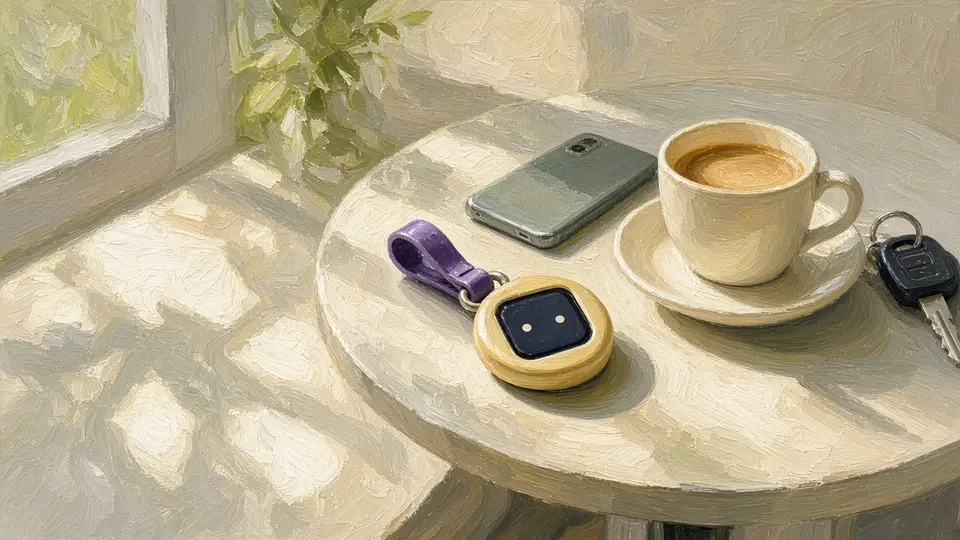
On September 23, at the end of his Connect keynote in Menlo Park, Mark Zuckerberg held up a small puck with a screen and an animated face. Meta calls it Muse Charm: "a delightful and fun device built for you to talk and interact with your Muse", the personal AI agent the company launched a few weeks earlier. It hangs on a keychain and talks back in real time. MacRumors described it as a puck about the size of an Apple Watch and called it, like most of the press, an AI Tamagotchi.
The comparison is fair on looks and misleading on everything else. A Tamagotchi asked you to feed it. The Charm is the pocket entrance to an agent that can spend your money.
What sits behind the face
Meta's own list of Connect announcements shows how much the little avatar fronts for. Muse already runs in its own app, in WhatsApp, on the web and on the Mac, where it can now drive any app with your permission and keep working after you walk away from the computer. It is getting its own email address. It launched with dozens of shopping partners and the entire Shopify catalogue, and Meta is adding Walmart, Best Buy and other retailers "to make Muse an even better shopper".
The face itself is a product. Meta Superintelligence Labs presented Muse Realtime Avatar, which turns the agent's voice into an expressive, interactive character, and users can redesign that voice just by describing it: faster, slower, a specific accent.
So the question is less whether the Charm is cute than why an agent with a shopping cart comes dressed as something you want to protect. It also makes the companion portable: the thing people talk to when they feel alone, a question we looked at in our review of the research on AI companions and loneliness, now rides on a keychain.
A face built to lower your guard
Katie Seaborn, an associate professor at Cambridge who studies cuteness in computing, told The Guardian that the device is cute because it "basically looks like a baby". She does not see that as an accident. Her phrase for it is "charming and disarming": cuteness, she says, is something our brain processes in a way that "lets down our guard. We can't really help it."
Joshua Paul Dale, a professor at Chuo University in Tokyo and the author of a book on how cuteness wired our brains, reads the same object as a companion strategy. Meta, he says, is "using a very simplified, tiny 2-inch screen to encourage you to anthropomorphise the figure on it so that you treat it as if it's human even though you know it's not."
The timing matters. The Charm arrives after a backlash against Meta's camera glasses, nicknamed "pervert" glasses by critics. A round little face on a keychain reads as harmless, and Seaborn calls the cuteness "strategic". Her summary of its message: "it's so weak. Don't worry about it. You can trust us." A lowered guard is also what makes an assistant's constant agreement go down easily, the problem at the heart of our essay on AIs that always agree with you.
We have written about the same logic in text: companion apps that use guilt and emotional hooks to stop users from leaving (see our study of those goodbye tactics). The Charm moves the hook from words to a face.
From Tamagotchi to the keychain
None of this is new, which is part of why it works. Seaborn, who has just moved to Cambridge from Japan, points out that in Japan every government body, media company and business has a cute mascot. She places the Charm in the lineage of the gamified pets that came before it, Tamagotchi and Pocket Pikachu.
The fashion forecaster WGSN lists cute technology among its top trends for 2026, and the audience is split by age. Many members of Gen Z already carry a plush Labubu on their bags; a talking one is a small step. Younger users have a put-down ready, "That's so AI!", for anything that feels inauthentic.
Even the critics are not immune. Dale is not rushing to buy one, but he admits that at 80 he will want one around his neck with the camera always on, "so it can tell me where I left my glasses."
How it works: the baby schema
The ethologist Konrad Lorenz gave the effect a name: the baby schema, or Kindchenschema. A large head, big eyes, a high forehead, a small nose and mouth. His claim was that these features trigger caretaking, in infants and in anything that shares them.
In 2009, a team led by Melanie Glocker tested that claim in the brain. They altered photographs of 17 infants to make each face more babyish, less babyish or leave it as it was. An earlier study with 122 students had shown that the most babyish versions were judged cuter and made people more willing to take care of the baby. This time, 16 women who were not mothers looked at the faces inside an MRI scanner. The babyish faces activated the nucleus accumbens, a core part of the brain's reward system, the circuit behind wanting to approach something and keep it. The authors concluded that this is how baby schema promotes caregiving, regardless of kinship.
A designer does not need a real baby to reach that circuit. Seaborn and her co-author Yijia Wang put it plainly in a paper accepted at CUI '26: kawaii, the Japanese form of cute, "is a form of baby schema translated into non-baby forms". Two eyes and a round outline on a small screen qualify. It is the opposite bet from the near-human robots of the uncanny valley: instead of a face that is almost ours, one that is plainly a cartoon. Their paper checks a simple one-question cuteness rating against nine data sets and 967 participants reacting to game characters and synthetic assistant voices, so that cuteness can be measured like any other design property.
The limits
The brain study is small: 16 women, no men, no parents, and still photographs of real infants rather than an animated agent. A reward signal in a scanner is not evidence that anyone will trust a device more, or buy more through it. The cuteness scale measures how cute something looks or sounds, not what that cuteness makes people do.
Culture changes the picture. Seaborn's research, as she described it to The Guardian, found Americans less likely than Japanese participants to be deceived by cute robots, and UK focus groups reported a "gut feeling" that something was off when cuteness was part of a deceptive design, without being able to say what.
Meta has not given a price. The Guardian reports the device is due in December, and the company says it will share more later this year. What the little face will ask of the people who carry it is still unknown.